- [email protected]
- Houston, Lucknow & Bhubaneswar
Blog Details
04
May
Workday Flex Credits & Platform Entitlements
1. What Are Workday Flex Credits?
Workday is transitioning from its traditional per-seat, unlimited-use licensing model to a consumption-based model for its AI and agentic capabilities. The currency for this model is Flex Credits.
Instead of purchasing access to a specific feature, customers buy (or receive complimentary) Flex Credits and spend them based on what they actually use. Credits are consumed when AI Agents perform work in your Production tenant and not in sandbox or lower environments.
Key characteristics of Flex Credits:
- Redeemable during the Subscription Period defined in your Flex Credit Order Form
- Applicable across current and future Workday AI Agent offers as soon as they are released
- Unused credits expire at the end of each Subscription Period; they do not roll over
- Additional credits can be purchased at any time through your Account Executive on a prorated basis
Overages are customer's responsibility—they do not cause service interruption but are billed at reconciliation
2. How Do You Get Flex Credits?
Existing Workday customers can add the Flex Credit & Platform Entitlement Policy to their agreement beginning Q1 2026 by signing an updated UMSA (Universal Master Subscription Agreement) addendum. New customers will have this included in their contracts by default.
Annual Complimentary Entitlements
Upon accepting the policy, Workday provides complimentary credits annually at no additional cost, sized by your product subscription and organization:
| Workday Module | Org Size | Annual Complimentary Credits |
|---|---|---|
| HCM or Financials | ≥ 100,000 employees | 200,000 credits |
| HCM or Financials | 30,000 – 99,999 employees | 120,000 credits |
| HCM or Financials | 10,000 – 29,999 employees | 60,000 credits |
| HCM or Financials | 3,500 – 9,999 employees | 30,000 credits |
| HCM or Financials | < 3,500 employees | 15,000 credits |
| Planning or Sana Enterprise (without HCM/FIN) | All segments | 5,000 credits |
Complimentary entitlements reset annually on the Policy Effective Date anniversary. They cannot be rolled over or duplicated across multiple Order Forms.
3. Platform Entitlements: The Other Meter Running in the Background
Alongside Flex Credits, your agreement includes baseline Platform Entitlements. These are NOT unlimited and exceeding them draws down your Flex Credit pool.
3.1 What Are Platform Components?
APIs: Production API requests (excluding Workday Agents, Core Connectors, and Built-on-Workday partner apps)
Integration Events: Custom integration processes built using Workday integration tooling (excluding EIB-based integrations)
Document Storage: GB of Production file storage (excluding files used exclusively in Contract & Document Intelligence, Strategic Sourcing, or Media Cloud)
3.2 Baseline Annual Entitlements by Org Size
| Org Size | API Calls (annual) | Integration Events | Document Storage |
|---|---|---|---|
| ≥ 100,000 employees | 6.5M calls | 80,000 events | 1,000 GB |
| 30,000 – 99,999 | 6.0M calls | 70,000 events | 850 GB |
| 10,000 – 29,999 | 4.5M calls | 50,000 events | 750 GB |
| 3,500 – 9,999 | 3.5M calls | 40,000 events | 650 GB |
| < 3,500 employees | 2.5M calls | 30,000 events | 500 GB |
3.3 Additional Entitlements for Specific SKUs
Customers with certain add-on subscriptions receive a percentage increase on API call entitlements only (Integration Events and Storage are unaffected):
| Add-on SKU | API Call Boost | Integration Events / Storage |
|---|---|---|
| Workday Extend | + 50% | No change |
| Prism Analytics | + 15% | No change |
| Workday Financials | + 15% | No change |
These boosts are additive and each is calculated against the Baseline (not stacked on top of each other).
4. What Counts Toward Your Entitlement and What Does Not
This is one of the most practically important distinctions in the entire policy. Not all integrations and API calls consume your entitlement:
| Does NOT count toward entitlement | DOES count (overage draws Flex Credits) |
|---|---|
|
Workday Core Connectors Enterprise Interface Builder (EIB) – Integration Events only Built-on-Workday (partner) applications Workday Agents listed on the Rate Card Sandbox / non-production activity (informational only) |
Custom Studio integrations and Orchestrations Workday Extend (custom) applications Modified Workday-built integrations External AI agents calling your Workday tenant Certified Partner integrations (API requests) |
Bottom line: If your organization runs heavy custom Studio integrations, Orchestrations, or Extend applications, your Platform entitlement will erode faster than you expect. Audit your integration footprint before committing to a Flex Credit volume.
5. How Are Credits Actually Consumed? The Rate Card
Credit consumption varies significantly depending on which agent you use and which specific capability within that agent you invoke. The marketing summary 'pay for what you use' is accurate, but the range is wide. Below is a representative view based on the published rate card:
| Agent / Action | Credits per Action | Approx. Cost* | Category |
|---|---|---|---|
| Self-Service Agent (Q&A, HR tasks) | 1 – 5 credits | $0.10 – $0.50 | Low |
| Business Process Optimize | 1 credit | ~$0.10 | Low |
| Payroll / Time Management tasks | 10 – 60 credits | $1 – $6 | Medium |
| Contract Negotiation / Redlining | 500 credits | ~$50 per document | High |
| Talent Rediscovery (Recruiting Agent) | 750 credits | ~$75 per req | High |
| Internal Talent Matching (Mobility Agent) | 750 credits | ~$75 per req | High |
*Approximate cost is illustrative, based on an estimated credit value of approximately $0.10 per credit. Confirm actual pricing with your Workday Account Executive.
Important nuance: The same agent may contain multiple skills with very different credit costs. For example, the Recruiting Agent's Candidate Grading feature runs approximately 6 credits per resume, but its Talent Rediscovery (Fetch) feature runs 750 credits per requisition. The agent is a bundle; always verify cost at the skill level, not the agent level.
6. Platform Overage Rates
When your Production usage of APIs, Integration Events, or Document Storage exceeds your baseline entitlement, the excess is charged against your Flex Credit pool at the following rates:
| Platform Component | Overage Rate | Approx. Cost* |
|---|---|---|
| API Calls | 60 credits / 10,000 calls | $0.60 per 10,000 calls |
| Integration Events | 25 credits / 100 events | $2.50 per 100 events |
| Document Storage | 120 credits / GB / year | $12 per GB/year |
*Approximate cost assumes ~$0.10 per credit. Document Storage overage is calculated on a daily fractional rate. Confirm actual pricing with your Account Executive.
If your Flex Credit balance reaches zero, you must purchase additional credits. There is no service interruption, but overages are reconciled at year-end.
7. Illustrative Cost Scenarios
The table below shows what annual Flex Credit consumption could look like for common use cases. These figures are illustrative and based on published rate card data. Your actual consumption will depend on usage volume, agent selection, and integration architecture.
| Scenario | Volume | Credits Used | Approx. Cost* | Note |
|---|---|---|---|---|
| Recruiting: Talent Rediscovery | 50 reqs/month | 450,000/yr | $45,000/yr | Single skill, one agent |
| Contract review & redlining | 100 docs/month | 600,000/yr | $60,000/yr | 500 credits/doc |
| Self-Service Agent (HR Q&A) | 5,000 interactions/month | 150,000/yr | $15,000/yr | Average 2.5 credits/action |
| Integration overages (Studio) | 500,000 extra events/yr | 125,000 | $12,500/yr | 25 credits/100 events |
*All cost figures are illustrative. Confirm pricing with your Workday Account Executive. Credits are assumed at ~$0.10 each.
Key takeaway: Self-Service and process-optimization agents are economically very favorable. Talent and contract agents, particularly those involving large data scans carry a per-transaction cost that can add up quickly at enterprise scale. Run the math for your specific volumes before greenlighting a pilot.
8. Monitoring: The Platform Consumption Console (PCC)
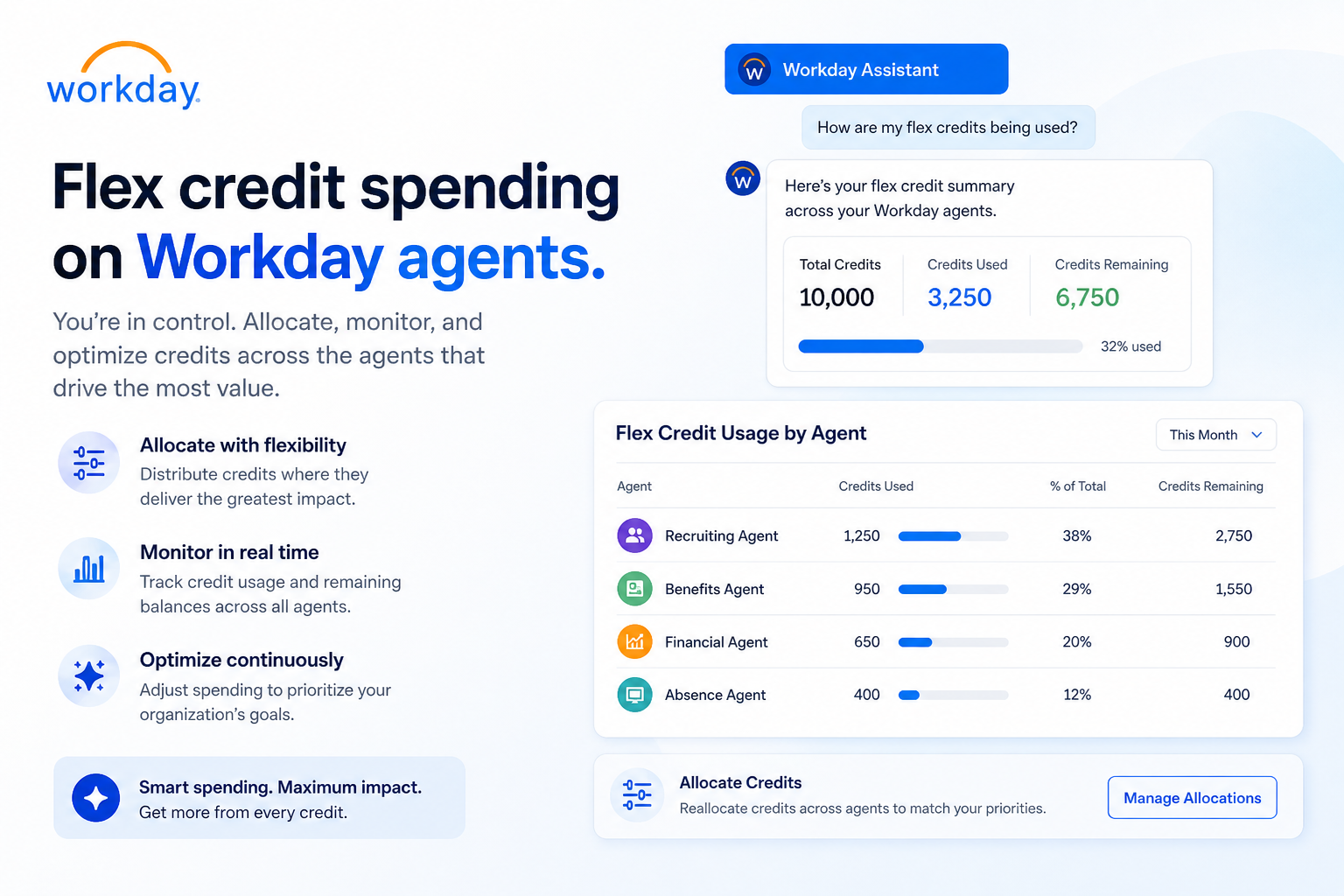
Workday provides a Platform Consumption Console (PCC)—a built-in tool for tracking your Flex Credit usage in real time. Key capabilities of the PCC include:
- Credit balance and burn rate visibility
- Usage breakdown by agent and platform component
- Access to the rate card history
- Alerts as usage approaches thresholds
- Role-based access controls
Recommendation: Identify the PCC administrator for your organization before enabling any agents in Production. Consumption-based billing has no automatic cap; budget overruns happen silently. Establish a governance cadence—monthly at minimum—to review usage and forecast end-of-year position.
9. What Is Not Changing
Flex Credits apply to agentic and metered capabilities. The following are unaffected:
- Existing Workday subscriptions and the Flexible Subscription Entitlement (FSE) model
- Embedded, non-agentic AI and machine learning features already included in your subscription (these do not consume Flex Credits)
- Sandbox and non-production tenant activity—no credits are consumed; usage is visible in PCC for informational purposes only
- Data export rights—customers retain free mechanisms to export their data as required by applicable law
10. Key Risks and Governance Considerations
10.1 Credit Burn Rate
Consumption-based pricing is intuitive in concept but requires active monitoring in practice. Without visibility, a single high-frequency agent or an unexpected integration spike can deplete credits well ahead of the annual reset.
10.2 Integration Footprint Exposure
Organizations with significant custom Studio, Orchestration, or Extend workloads may exhaust their baseline Platform Entitlements earlier than anticipated. This is the most common blind spot in initial Flex Credit planning.
10.3 Agent-Level vs. Skill-Level Pricing
The marketing summary of Flex Credits often cites low per-action costs. Always validate cost at the individual skill level, not the agent level. High-complexity skills within the same agent carry significantly higher per-run costs.
10.4 Cross-Departmental Governance
AI adoption rarely stays within a single team. Without clear credit ownership across HR, Finance, IT, and Operations, multiple teams may independently activate agents, making it difficult to forecast total spend or prioritize allocation.
10.5 Credit Planning Discipline
Over-purchasing leads to stranded credits at year-end (unused entitlements expire). Under-purchasing limits access to capabilities mid-year. The right sizing requires visibility into your tenant's current API and integration volumes—ideally before signing the Flex Credit addendum.
11. Recommended Next Steps
- Confirm your UMSA status with your Workday CSM—agents cannot be enabled without the updated agreement
- Audit your current integration architecture: identify Studio integrations, Orchestrations, Extend apps, and third-party API consumers against your tenant
- Determine your baseline Platform Entitlement tier using the org-size tables in Section 3
- Map intended agent use cases to the rate card and model annual credit consumption using the scenarios in Section 7 as a starting framework
- Request that your Account Executive share the full Rate Card and confirm your credit pricing
- Establish a governance cadence before enabling any agents in Production
- If your organization runs complex integrations or is considering talent- or contract-focused agents at scale, engage a Workday partner to model total cost of ownership before committing